Tuesday, March 23, 2010

Film Lesson: "Schindler's List"


In our Global 4 class, we watched the movie "Schindler's List". This movie illustrated the Holocaust in a less disturbing manner. The movie also threw in some romance to make the story a bit more interesting, I guess you could say. Although the movie included fictional scenes of the Jews being taken away to the concentration camps and being killed and tortured, it still was not as powerful as "Night and Fog". This does not mean that "Schindler's List" didn't leave me upset and bothered. Something that was powerful to me as a viewer was how the children were roughly taken away from their parents by the Nazis. They would be taken to work at the concentration camps and they were to be tortured if they didn't obey the Nazis that ran the camps.

Another thing in the movie that bothered me was how the children would have to view all this violence happening around them. They probably saw their own neighbors get violently beaten to death. That is something that can be very traumatizing for these children at such a young age. It's sad to know that some of these children didn't live long enough to finally be liberated. These children probably had goals they wanted to achieve in the future and their dreams were crushed just because of cruelty and prejudice. As I said in my previous blog, I believe "Night and Fog" was more powerful than "Schindler's List". Seeing the real stuff has a more powerful effect than a Hollywood version. Most of the scenes in "Schindler's List" will stay in my head for a minimal amount of time, but the many scenes in "Night and Fog" will definitely stay in my head for a larger amount of time, if not as long as I live. Again, I say that the Holocaust is an event in history that I will never forget reading and learning about.

Film Lesson: "Night and Fog"


The Holocaust is an event in history that I will never forget reading and learning about. What happened in those concentration camps was absolutely devastating and tragic. I also think that the Nazis who ran those concentration camps were sick! The scenes and pictures in the documentary "Night and Fog" not only broke my heart but they also caused me to feel furious. It broke my heart because of what these poor Jews had to suffer, especially the children. I can't imagine being taken away from my home all of a sudden one day to be taken to that hell hole. The Jews were tortured and killed just because they were Jewish. It was like they were living in a terrible nightmare. That is wrong on so many levels. This is what made me feel furious. The Nazis killed the prisoners just because they were Jewish. That really bothers me. I cannot believe how heartless and cruel these people were.

In my opinion, "Night and Fog" was definitely a very powerful movie. The scenes of the Nazis beating and killing the Jews is what really made the movie powerful. Compared to the movie "Schindler's List", this movie illustrated the Holocaust more effectively. The reason why is because the scenes and pictures shown are all real and they are also images that I will never forget seeing. The Hollywood version may have been upsetting but the documentary shows you what really happened and what the Jews really suffered. The documentary is all facts while the Hollywood version includes romance and such, like many other Hollywood movies about historical events.

Sunday, February 28, 2010

The Treaty of Versailles (ended WWI)


The Treaty of Versailles was signed by Germany and the Allied powers on June 28, 1919. This was the peace treaty that officially ended World War I. The Treaty of Versailles had a very negative effect on Germany. The Treaty of Versailles required that Germany accept sole responsibility for causing the war. They also had to make reparations to members of the Allied forces. Germany suffered the loss of 10% of their land and their overseas colonies away and shared between the Allies. 12.5% of the German population found themselves living outside of the new German borders.

The condition of the German economy went downhill as a result of the produce and profit being sent to the Allies as reparation payments. So, the German economy was unfortunately unable to recover itself. The Germans were also excluded from the league of nations and were enforced to live under other people's rule. This caused them to feel discontent. I don't think this treaty was fair for the Germans because it wasn't completely their fault. Sure, they did some things that may have sparked the beginning of the war but to put all the blame on Germany is just wrong. Other countries were involved in the war.

It is possible that the Treaty of Versailles led to the rise of fascism and Adolf Hitler. Germany was a huge mess after the Treaty of Versailles and Hitler offered to do something constructive about the hurt pride of Germany and he offered a way to lead the country out of shame and out of their bad living conditions. The way Hitler spoke had impressed the Germans and they allowed him to help them through the difficult time. As time went by, Hitler kept rising to the top after taking control of Germany. Maybe this is the reason why historians say that the Treaty of Versailles led to the rise of Hitler.

Wednesday, February 24, 2010

Mustafa Kemal (Ataturk) and the Modernization of Turkey


Mustafa Kemal Ataturk did certain things to make Turkey more secular. Secular can mean being more worldly and not exactly focusing on religion so much. If you are secular, you are basically non-religious and less spiritual. Mustafa Kemal made reforms in the political, social, legal, economic, and cultural parts of Turkey. The Turkish people were more than happy to accept these reforms into their lives.Before becoming a leader in Turkey, he was a military hero at the Daradanelles in 1915. It was after this that Mustafa became the charismatic leader of the Turkish national liberation struggle in 1919. He was very successful in getting rid of invaders and leading the nation to victory and this led Turkey to their full independence. Because of Mustafa's high achievements, the Ottoman Empire was put to rest and he created the Republic of Turkey in 1923.


Mustafa aimed to modernize Turkey so that they would have a brave new future after going through so much in their past. One reform Mustafa made was that he created a secular system where the vast Muslim majority and the small Christian and Jewish minorities were free to practice their faith. Mustafa had also stressed the importance of the peasants, something that is rarely ever seen. This was something big because the peasants were neglected during the Ottoman times. Mustafa also made other reforms like having European hats relace the fez and having woman stop wearing the veil. Additional reforms included having all citizens take surnames and the Islamic calendar was to stop operating in order for the Western calendar to be moved in. After the cancellation of capitulations, the factors needed to secure a national and liberal economy were achieved. Thanks to Mustafa's reforms, Turkey's economic structure was completely changed for the better.

Thursday, February 18, 2010

Film Lesson: "Gandhi"


Mahatma Gandhi was born in 1869 in western India. He is well known for helping India gain independence. Gandhi was not satisfied with the way Indian people were treated by the British. They did not have many rights and this infuriated Gandhi. He decided that it was time for the Indians to stand up against the British. One thing Gandhi and the Indians did was that they refused to buy clothing from the British. Instead they would make their own clothes. Gandhi already made his own clothes by using yarn and a spinning wheel. He would take time out of his day just to this. Gandhi wanted the Indians to do this so that the British sale of clothing would decrease, therefore decreasing their profit along with it.


Gandhi and his followers then went on a 200 mile walk to the coast. When they got to the sea, they began to make salt out of the sea water by collecting it and letting it evaporate. By making their own salt, they wouldn't be buying salt from the British. Gandhi didn't like the idea of violence so he protested peacefully with acts of non violence. Since making their own salt was illegal, many of Gandhi's followers were thrown into jail and were victims of police violence. Even though the police beat them, they refused to defend themselves because of the teachings of Gandhi. Gandhi believed that reacting to situations with violence lead to even more violence. If his followers were involved in acts of violence, he would fast. His followers would immediately stop because they did not want Gandhi to die from starvation.

Wednesday, January 13, 2010

The Russian Revolution


The Russian Revolution took place in 1917. It was led by Vladimir Lenin. The word revolution means change so obviously the Russians had a revolution because they wanted a change in their nation. The Russian Revolution had taken place during World War I. It was Czar Nicholas II that brought Russia into the war. While the Russians were cold and starving in the years 1916-1917, Nicholas just kept sending troops to war. That is one reason for why people wanted a change in the government. They didn't want to keep starving. That wasn't the worst part. The Russian economy was going downhill at the time. With food shortages, the prices for food went up. This led workers to go on strike so that their wages would increase. In 1917, those who were on strike marched through the streets of Petrograd breaking shop windows and yelling out anti-war slogans. Peasants were also greatly affected because they were already poor.


While the Russians were starving at home, the troops were dying at war. Since Russians weren't equipped with the necessary supplies they needed to fight at war, many troops were dying, getting injured, and getting captured by the enemy. How were they supposed defeat the enemy if their military skills and equipment were lacking? The Russians probably had this in their heads during the Russian Revolution. I don't blame them for deciding to revolt. Nicholas II left the throne in February 1917. This tells us that a main cause of the revolution had to do with the way Russia's condition was politically. Their condition economically wasn't so great either. Vladimir Lenin created the slogan "Peace, Land, and Bread" because he promised Russia these three things. He promised them peace because the Russians weren't at rest. They were fighting World War I for a few years now. Lenin promised them land because having land back then allowed you to be successful. It was essential. Lenin promised Russia bread because, as I said before, they were in a famine, meaning there were food shortages. They were suffering through starvation.


Causes for WWI


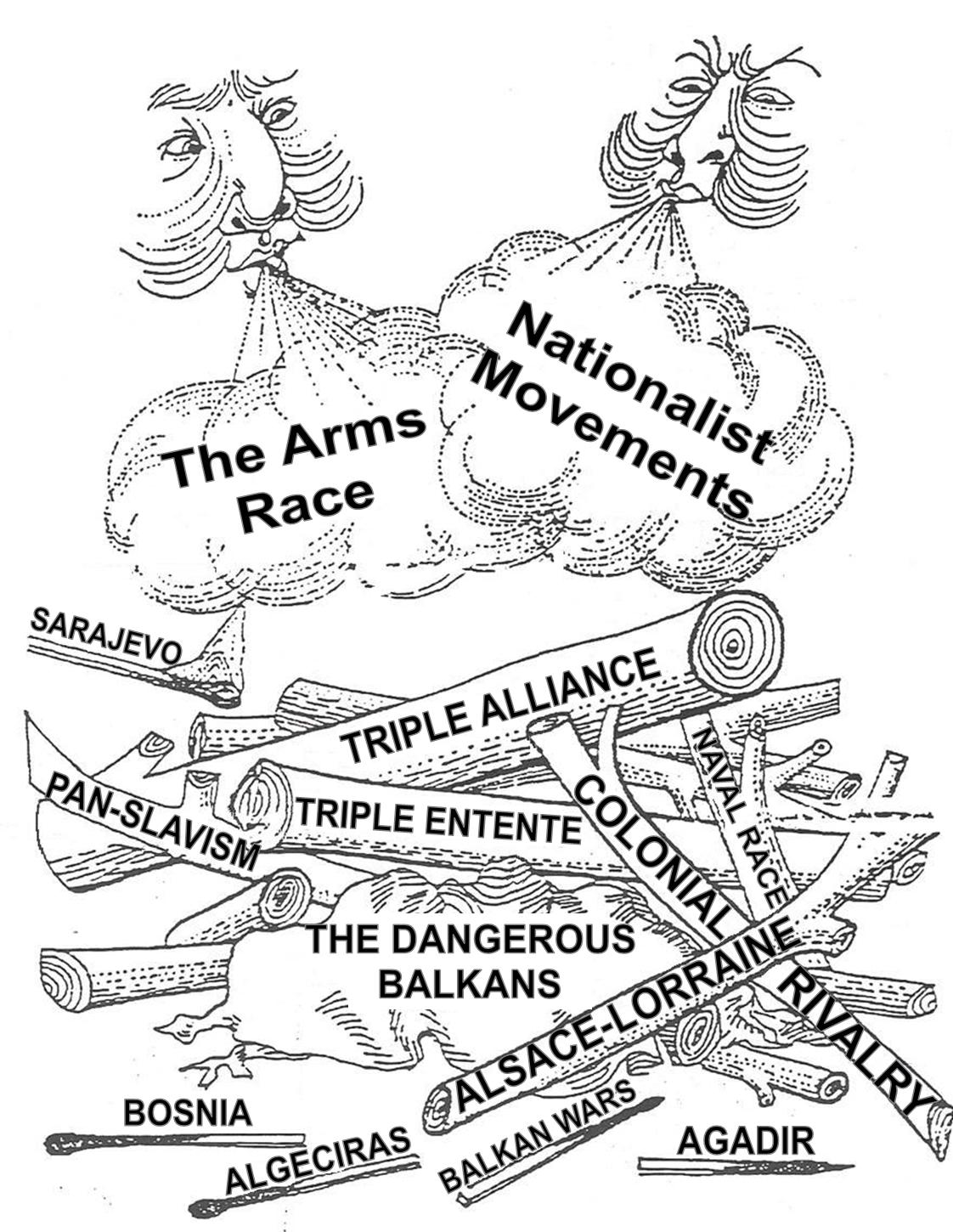
World War I broke out in the year 1914. Like all other wars in history, there were reasons for why World War I started. One of those reasons was militarism. Militarism can be defined as the belief that a strong military force is beneficial. During the years before the war, some countries in Europe built large armies and navies and powerful military officers took charge of the civil authorities. The militaries of each country had also planned mobilization during this time as well. Because of these secret battle plans, other countries began to spy on. The results of this were that there was an increase in the hatred and the fear from one country to another. With countries organizing and preparing for war, of course other countries would start to fear you. They would also want to prepare themselves as well while also trying to make sure that their ways of preparing were better than the other country's ways of preparing for war.


Another cause of World War I was nationalism. Nationalism is loyalty and pride for one's own country. Many countries in Europe had a lot of pride in themselves. They believed that they were better than other countries. Germany was one of the countries that showed their pride by making nationalistic speeches and text. When the other countries in Europe heard about this, they wanted to show Germany that they were not better than them. They wanted Germany to lose the feeling of national superiority.


One of the other causes of World War I was the assassination of Archduke Francis Ferdinand on June 28, 1914. He was assassinated during his visit to Sarajevo by a Serbian nationalist. This had angered the people of Austria-Hungary because Ferdinand was the heir to the Austrian throne. They considered the assassination an open attack from Serbia. Now Austria wanted to make sure that Serbia was no longer a threat to Austria, but they knew that if they were to start a war with Serbia, they would need the support of Germany. Germany agreed to help Austria because they believed that Austria was an ally of Germany.