Thursday, December 10, 2009

Film Lesson: "Mountain of the Moon"


Recently in our Global 3 class, we watched a movie called "Mountains of the Moon" featuring Richard Burton and John Speke. While these two men explored Africa, they experienced many hardships, just like many other Europeans at that time. In Africa, diseases caused by mosquitoes, like malaria, were very common. This is why Burton and Speke were shown sleeping with mosquito or insect guards over them. There was one scene in the movie where John Speke was sleeping without a guard to protect him from the insects. This caused a beetle to crawl into his ear. They had to drop hot wax into Speke's ear and soon after Speke jammed a spear into his ear. Another hardship faced by these two men in Africa was when they entered a different territory. In one of the scenes of the movie, Burton and Speke entered the territory of a group of "colorful" Africans. They told the men that they could not enter their territory without bringing them gifts. In some cases in history, people have gotten into battles because one person entered a different territory without the permission of its owner.


Burton and Speke came across a body of water. They named this body of water Lake Victoria, after the Queen of England. This is very strange because they named a lake after the Queen of England and this lake is located in Africa. It would make more sense if they named a body of water in England after the Queen of England or if they named that body of water they encountered in Africa after an African leader. The movie had a scene where one of the two men took out a gun and threaten one of the Africans. The Africans appear to have not known what this object was. This is one of the primary technological advantages that Europeans had over Africans during this time. Europeans were more updated with their weapons. Europeans were eventually able to conquer Africa so easily not only because they were more advanced in their technology but because they were also more united than the Africans. The African people had different tribes who would occasionally end up in a battle with each other for land most of the time. Europeans, on the other hand, worked together and were more united. With teamwork, of course you can wipe out the other team.

Monday, December 7, 2009

Imperialism Project


Over the past couple of days, our Global 3 class has been working on an Imperialism project because we are currently working on the Imperialism unit. We completed this project so that our class could see the effects of imperialism. Imperialism is when a powerful country or nation takes over another foreign territory. For this project, we attached things like cotton, tea, gold, and products related to that onto the project map. We also drew shipping lines on the map to show the trade routes of some of the countries. For example, England needed cotton to make more clothing in their factories, especially since there was an increase in demand for clothing. They discovered that India had cotton in their country so they decided to sail to their country to get the goods they needed.


For this project we also colored in countries, not only because our teacher wanted the paper to look pretty, but to show which countries took over which territories. My partner and I learned that England took over places like Canada, Eastern United States, and many countries in Africa. There was a slave trade between the New World and Africa during this time as well. Spain took over many countries in South America and a few countries in the Caribbean. This can explain why many countries in South America and in the Caribbean speak Spanish today. This project helped us learn that European countries participated the most in imperialism.

Thursday, November 19, 2009

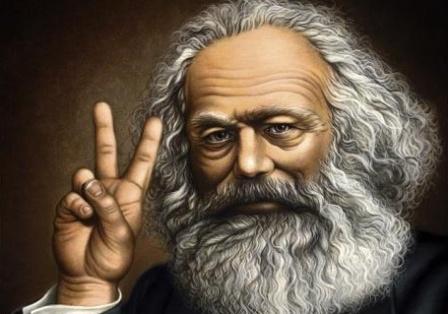
Karl Marx and Communism


Communism is basically a system that has a goal to get rid of private ownership and to also get rid of the classes of a society. Karl Marx was not happy with the Industrial Revolution. He believed that it was wrong how the factory owners would most of the money while the factory workers worked long, exhausting hours and got paid a low amount of money. Karl Marx's idea of communism was pretty much the same as the definition I provided above. He wanted everyone to share equal wealth, not one person to be paid more than the other just because of their position in the classes of the society.


Karl Marx wanted communism to take over the world because he believes that history has been a series of class struggles, mainly between the working class and the owners of the capital. The owners of the capital would be having all the fun while the working class would work these long hours with only a short period of time for food. This is why Karl Marx saw the owners of the factories as the 'bad guys' and the factory workers as the 'good guys'. He predicted that the 'good guys' would stand up for themselves and try to overthrow the 'bad guys' so that they could try to make a change of the situation.

Tuesday, November 17, 2009

Karl Marx and the Industrial Revolution


Due to the poor treatment of workers in Europe, Karl Marx wasn't seen as a big fan of the Industrial Revolution. Women and children had to be sent out to work in factories just so that they could support their families since they were poor. They had no other choice after being struck with poverty. Factory owners liked that children were available to work because they were easier to control. The heartbreaking thing was that they were controlled by being violently beaten so that they could follow orders. Children were used to get coal from unsafe places in the mines and since they had small hands they would be ordered to reach into parts of machines. Sometimes young workers were forced to work eighteen hours a day, which didn't leave a fair amount of time for a much needed rest. Workers in a factory weren't even paid a well amount of money.


This is the reason why Karl Marx believed that factory workers should control the factories instead of the landlords. Maybe that way conditions wouldn't be so unjust. Karl Marx wanted workers to become one and go against their factory owners instead of keeping quiet and continuing to be treated unfairly. Factory owners lived the good life, something they did not deserve. It is the main reason why the Industrial Revolution inspired Karl Marx to invent Communism. Communism is basically the idea that people share the same wealth in a society. Communism wasn't all that good, though. These types of governments were strict and dictatorial. Workers would be forced to work on massive pieces of farmland. Those who wanted to print news stories criticizing the government weren't allowed to. If they decided to go against the Soviet government, they would suffer the harsh consequences.

Tuesday, October 27, 2009

Nationalism and the Creation of Italy


Nationalism is basically showing that you belong to your country and showing that you have loyalty to your country by showing your support in different ways. I am nationalistic because I celebrate the 4th of July, which is Independence Day for the U.S. I also use my country's currency, which is the dollar, and I also support the troops that fight for my country. If my country would go against another country in the Olympics, for example, I would most likely root for my country.


Nationalism can bring people together by making them feel connected. In my country, we feel connected because the troops fighting in a war right now are fighting for our country. Nationalism was used to create the nation of Italy. This happened in the early 1800s when people from Italy became interested in the traditions and culture of Italy. After the French Revolution, people in Italy also thought that they also need equality and freedom. Before Italy was the Italy we see it as today, it was made of small kingdoms. Most of Italy was controlled by Austria while the remaining land was separated into nations. Italy became its own country after many battles with Austria. Just like our country wanted independence from Great Britain, Italy wanted to fight so that they could be independent from Austria.

Thursday, October 22, 2009

Simon Bolivar and Latin American Revolutions


Simon Bolivar, born in Caracas, Venezuela on July 24,1783, was a South American general. He was actually considered one of South America's greatest generals. When he was young, he was sent to Europe to go to school in Spain. Soon after, he returned to Venezuela and got married. Unfortunately, though, his wife died shortly after their wedding. Bolivar went back to Europe and then traveled to United States, which had just won its independence from Great Britain. When Bolivar went back to Venezuela, he decided that it was time for his country to be independent from Spain.


In 1810, Bolivar joined a group of men that captured Caracas and the announcement of independence from Spain was made later on. But, Spain did not want to give up the land so they attacked Bolivar and his men, resulting in one of his men surrendering. Bolivar traveled to New Granada, which is the country Colombia today, and wrote Cartagena Manifesto. In Cartagena Manifesto, Bolivar said that New Granada should help him in his quest for Venezuela's independence because they both want the same thing and Venezuela's freedom would protect the freedom of New Granada. After receiving help from New Granada, Bolivar invaded Venezuela in 1813.


Bolivar was forced to go back to New Granada by the Spaniards. In 1815, Bolivar traveled to Haiti and managed to convince their president to help him on his quest. A couple of years later Bolivar went back to South America to continue his quest. Bolivar and his army won the Battle of Boyaca in 1819 and in that same year he created the Angostura Congress, which founded Gran Colombia, and Bolivar was named president. After another battle in 1822, northern South America was finally liberated. But, that was only the northern part. Bolivar and his army then prepared to march through the Andes Mountains to liberate Peru. In 1823, Bolivar was given the role to invade Peru and soon after he was given the role he arrive in Lima to plan the attack.


Finally, in 1824, Bolivar and his army defeated the Spanish army in a few more battles to finally remove the Spaniards from South America. The Republic of Bolivia was created in the Congress of Upper Peru in honor of Bolivar, since Peru had become a separate state. Without Bolivar's determination and perseverance, Bolivia might have never existed. He wanted to defeat the Spanish and gain independence from Spain and he did.


Thursday, October 1, 2009

John Locke And "The Enlightenment"


John Locke's ideas during The Enlightenment are very similar to what Thomas Jefferson wrote in the Constitution because he had a great influence on Thomas Jefferson when he was writing the Constitution. The "rights" that Thomas Jefferson talks about in the Constitution include life, liberty, and the pursuit of happiness. He is trying to say that everyone is created equally so, therefore, they should be able to have the same freedom as others in their nation and they should be able to live their lives how they choose to, with no one forcing them to do things that they don't want to. People in the nation should have equal rights, no one should have more rights than others and they also shouldn't have less rights then others as well. According to the Declaration of Independence, the governments power comes from the people of the nation. This could mean that the people of the nation have the right to change or get rid of the government if they thought the government was doing very bad. They would then set up a new and more improved form of government.